
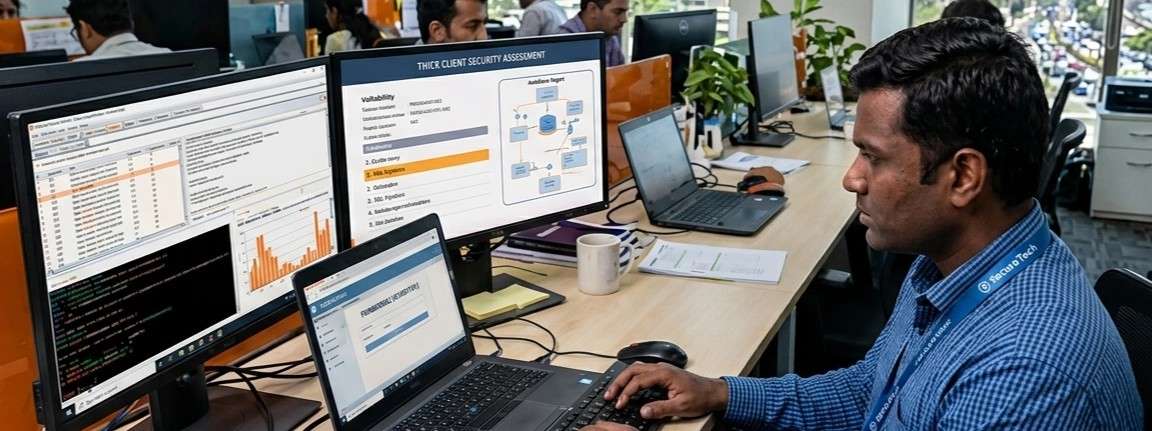
Thick Client VAPT
Find security gaps inside desktop applications
Key highlights
- Desktop application security testing across binaries, runtime, and data storage
- Reverse engineering and local security weakness identification
- Runtime, network, and API interaction analysis
- Validation of real exploitation paths including SQL injection and RCE scenarios
- CERT-In empanelled, ISO 27001 certified

The challenges Indian businesses face
Executable logic is exposed to attackers: Unlike browser-based applications, thick clients give attackers direct access to binaries installed on user endpoints. That makes reverse engineering, logic abuse, and offline analysis far easier if security controls are weak.
Local data and configuration are often insecure: Desktop applications frequently store sensitive data in local databases, files, logs, or configuration stores. If these are not properly protected, attackers can extract credentials, business data, or encryption material directly from the endpoint.
Weak obfuscation is not real protection: Many thick client applications rely on basic obfuscation and assume the application logic cannot be understood. In practice, weak obfuscation can often be bypassed, exposing authentication flows, validation logic, and backend interaction patterns.
Traditional web VAPT does not cover this attack surface: A standard web or network assessment will not fully test binary-level flaws, insecure local storage, runtime abuse, or reverse engineering risk. Thick client applications need a different testing approach and a different skill set.

The Matrix3D solution
Binary analysis and reverse engineering: We decompile and inspect application binaries using tools such as ILSpy and dnSpy to understand internal logic, authentication methods, sensitive workflows, and client-side trust assumptions.
DLL and dependency inspection: We analyse third-party libraries, runtimes, and dependency chains to identify outdated components, embedded weaknesses, and inherited security risks within the application stack.
Cryptographic review: We evaluate encryption routines, key handling, certificate usage, and hardcoded secrets to identify weak cryptographic implementations or insecure protection of sensitive material.
Local data and storage security: We assess local databases, cache files, configuration files, logs, and other storage mechanisms to identify data leakage risks and insecure persistence of sensitive information.
Runtime behaviour analysis: We monitor the application during execution to understand file system activity, process spawning, inter-process communication, and endpoint behaviour that may introduce exploitable conditions.
What you gain
Deeper visibility into desktop application risk
Understand how attackers can analyse, tamper with, or abuse your thick client application beyond what standard web or infrastructure testing would reveal.
Validation of real exploitation paths
See which flaws can be used to extract data, bypass controls, or compromise connected systems: rather than relying only on theoretical observations.
Better protection of sensitive local data
Identify weaknesses in local storage, configuration handling, secrets management, and application design before they become a source of breach or fraud.
Actionable remediation guidance
Get practical recommendations that help your developers and product teams fix the issues that matter most: based on exploitability and business impact.
Stronger client-server trust validation
Identify where the application trusts the client too much, allowing attackers to tamper with requests, bypass business rules, or trigger backend vulnerabilities through the desktop interface.
Improved confidence in release security
Assess whether the desktop application is secure enough for deployment by identifying exploitable weaknesses before release, reducing the risk of post-launch incidents, support issues, or emergency fixes.
Typical Thick Client Security Findings
Matrix3D has experience identifying thick client security issues such as SQL injection paths, insecure local database access allowing full data extraction, potential remote code execution scenarios due to unsafe handling of external inputs, and weak or bypassable obfuscation that exposes sensitive application logic.
Explore Related Cyber Security Services:
Why Matrix3D for Thick Client VAPT
- We test thick client applications using a real attacker mindset: reverse engineering binaries, analysing runtime behaviour, and validating backend trust boundaries.
- We combine desktop application analysis with API, storage, cryptographic, and exploitation testing in one engagement.
- Our reports are built for both developers and business stakeholders: clear evidence, realistic impact, and practical remediation priorities.
- With CERT-In empanelment, ISO 27001 certification, and enterprise assessment experience, we bring credibility and depth to every engagement.