
Cybersecurity is no longer only about protecting laptops, installing antivirus software, or putting a firewall at the office.
Businesses today operate through connected identities, cloud platforms, email, mobile devices, applications, vendors, data repositories, and increasingly, AI tools. This connected environment helps organisations work faster, but it also creates more routes that attackers can try to misuse.
The Microsoft Digital Defense Report 2026 provides a detailed view of this changing threat landscape. Based on Microsoft’s global security signals and threat intelligence, the report highlights how attackers are targeting trusted identities, business systems, cloud workloads, data, relationships, and AI environments.
For Indian small and mid-sized businesses, the report carries a clear message. Cybersecurity cannot remain a collection of separate tools and annual exercises. It must become a continuous business practice, supported by the right technology, processes, governance, and expert guidance.
The scale of cyber risk is changing
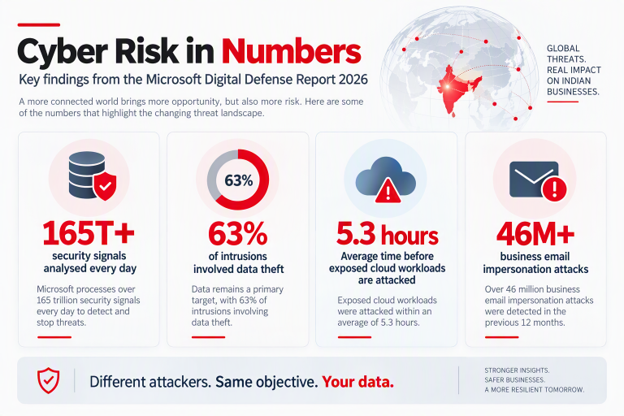
Microsoft processes over 165 trillion security signals every day. According to the report:
- 63% of intrusions involved data theft
- Exposed cloud workloads were attacked within an average of 5.3 hours
- Over 46 million business email impersonation attacks were detected during the previous 12 months
- Between 89% and 95% of email phishing attachments led to an attempt to steal credentials
These numbers are global, but the risks are relevant to Indian businesses of every size.
An attacker does not necessarily look at whether a company is called an SME or an enterprise. They look for exposed systems, weak passwords, unprotected accounts, excessive permissions, unpatched devices, misconfigured cloud services, and employees who may respond to a convincing email or phone call.
A growing business may also have a complex environment without realising it. It may use Microsoft 365, multiple business applications, remote access, personal and company-owned devices, cloud storage, external vendors, and new AI tools. If these systems are not governed together, security gaps can remain unnoticed.
The objective is not to react with fear or purchase more tools immediately. The objective is to understand where the organisation is exposed and strengthen the areas that matter most.
Identity is now the foundation of cyber defence
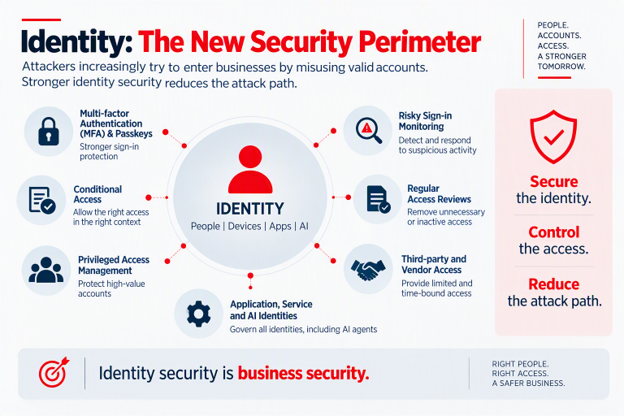
One of the strongest messages from Microsoft’s report is that identity has become the primary control plane for defence.
In simple terms, attackers increasingly try to enter a business by misusing a valid account. If they obtain an employee’s username, password, session, or authentication token, their activity may initially look like normal business access.
This makes identity security a priority for every organisation.
Businesses should ask:
- Is multi-factor authentication enabled and enforced for every user?
- Are administrator accounts separated from normal working accounts?
- Are former employees and inactive users removed promptly?
- Do users have access only to the systems and data required for their role?
- Are privileged accounts and high-risk sign-ins monitored?
- Are third-party vendors given limited and time-bound access?
- Are application, service, and AI-agent identities governed as carefully as employee identities?
Basic MFA is an important starting point, but businesses should also consider stronger controls such as phishing-resistant authentication, passkeys, Conditional Access, privileged-access management, and regular access reviews.
Microsoft Entra can help organisations manage identities, access policies, authentication, and risk signals. However, the effectiveness of these controls depends on how well they are configured and maintained.
Simply having a Microsoft 365 subscription does not automatically mean every recommended security control is active.
People remain an important part of security
Technology can block many attacks, but employees continue to be targeted through phishing, impersonation, social engineering, ClickFix-style techniques, business email compromise, and voice-based fraud.
AI is making these attempts faster and more convincing. A phishing email may use better language, include relevant business context, or appear to come from a senior colleague, customer, bank, courier partner, or vendor.
For Indian businesses, common situations may include:
- A payment request appearing to come from a senior executive
- A vendor sending revised banking details
- A fake Microsoft 365 login page asking an employee to sign in
- A message asking someone to open an invoice or GST-related attachment
- A caller pretending to be from IT support
- A request to reset MFA or share an OTP
- A link claiming that an email account or cloud subscription will be suspended
Employee awareness training is useful, but awareness alone is not enough. It should be supported by email protection, endpoint security, identity monitoring, device compliance, restricted administrative access, and a clear process for verifying unusual requests.
Employees should also know exactly whom to contact when something looks doubtful. Quick reporting can help the security team act before a suspicious event turns into a larger incident.
AI is creating value and a new attack surface
Many Indian businesses are already experimenting with generative AI, copilots, chatbots, automation tools, and AI agents.
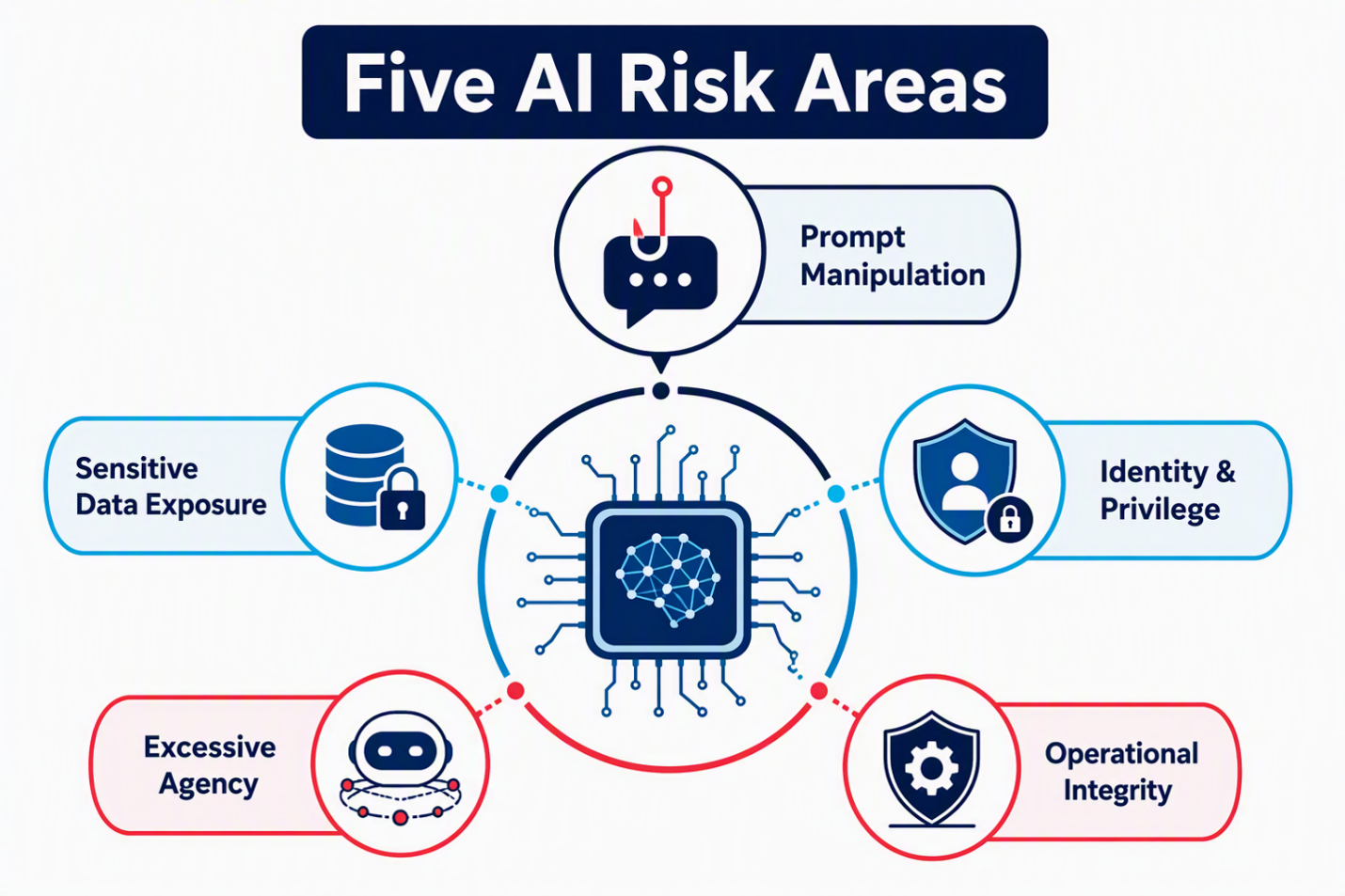
These tools can improve productivity, but they can also increase risk when introduced without proper governance. Microsoft’s report identifies five important areas of AI-related risk:
- Prompt and intent manipulation
- Sensitive data exposure
- Identity and privilege compromise
- Excessive agency
- Operational integrity risks
These risks are not limited to organisations building their own AI models.
An employee may paste customer information, source code, a contract, financial data, or internal communication into an unsanctioned AI tool. An AI assistant connected to SharePoint may be able to discover files that were previously difficult to find, including files that were overshared. An agent with excessive permissions may be able to perform actions beyond its intended role.
Businesses adopting AI should therefore review:
- Which AI tools employees are using
- What information is being entered into those tools
- Which data sources an AI assistant can access
- Whether AI agents have their own controlled identities
- What actions an agent is allowed to perform
- Whether high-impact actions require human approval
- How prompts, responses, logs, configuration, and memory are protected
- Whether AI applications have been tested for prompt injection and data leakage
AI security should not be handled after deployment. It should be included during solution design, access planning, testing, and ongoing monitoring.
Five risk areas to address when governing AI systems and agents.
Data protection becomes more important as AI adoption grows
AI systems can search, combine, and present information at a much faster scale than a human user leading to Shadow AI. This makes data governance an essential part of AI readiness.
Before expanding the use of Microsoft Copilot or other AI assistants, businesses should understand where their sensitive data is stored, who can access it, and whether it is being shared outside the organisation.
For an Indian business, sensitive information may include:
- Customer and employee personal data
- PAN, Aadhaar, banking, payroll, and insurance information
- Commercial agreements and contracts
- Business plans and financial reports
- Technical designs and source code
- Vendor information
- Health or background-verification records
- Proprietary processes and intellectual property
Practical protection measures can include:
- Reviewing access to SharePoint, OneDrive, Teams, email, and business applications
- Removing unnecessary external sharing
- Identifying sensitive and personal data
- Applying sensitivity labels
- Implementing data loss prevention policies
- Defining retention and deletion requirements
- Restricting downloads and access from unmanaged devices
- Reviewing vendor and third-party access
- Monitoring the movement of sensitive information
- Establishing rules for the acceptable use of AI tools
Microsoft Purview can support data discovery, information protection, data loss prevention, retention, and compliance requirements. These controls should be configured according to the organisation’s actual data, business processes, regulatory obligations, and risk profile.
For Indian businesses, data governance should also be aligned with the organisation’s privacy and compliance responsibilities, including requirements under the Digital Personal Data Protection framework.
Connected risks require connected visibility
Many businesses have already invested in security. They may have antivirus software, a firewall, email filtering, MFA, backup, and a cloud platform.
The gap often lies in visibility.
An unusual email may appear harmless when seen alone. A risky sign-in may also appear manageable on its own. A newly registered device or unusual file download may not trigger immediate concern.
When signals from identity, email, endpoints, cloud applications, data, and the network are connected, they can reveal a much clearer attack pattern.
This is why integrated detection and response are becoming important. Tools such as Microsoft Defender XDR and Microsoft Sentinel can help connect signals across the organisation. However, technology must be supported by proper configuration, alert prioritisation, response procedures, and skilled monitoring.
A large volume of alerts does not automatically mean stronger security. Businesses need meaningful visibility, actionable alerts, defined ownership, and a clear response plan.
Move from patch counting to exposure reduction
Microsoft’s report recommends a shift from tool-centric vulnerability management to continuous threat exposure management.
This is an important change for business leaders.
Security reports often focus on activities such as the number of patches installed, alerts received, or tools deployed. These figures may show that work is happening, but they do not always show whether business risk is reducing.
A more useful security review should ask:
- How many critical exposures have been closed?
- What percentage of users are protected by strong MFA?
- How many dormant accounts have been removed?
- Are privileged accounts separated and monitored?
- Have excessive permissions been reduced?
- Have sensitive-data locations been identified?
- Has unnecessary external sharing been closed?
- Has detection coverage improved?
- How quickly can a high-risk incident be identified and contained?
- Can important systems and data be recovered within the required time?
These measures help management understand whether the organisation is becoming more resilient, not merely more active.
A practical cyber defence agenda for Indian SMBs
The findings in the Microsoft report can feel extensive, especially for a small or mid-sized business with a lean IT team.
The answer is not to implement everything at once. A structured, risk-based approach is more practical.
- Understand the current environment
Create an accurate view of users, devices, cloud services, applications, vendors, business data, AI tools, and internet-facing systems.
- Identify priority exposure
Review identity controls, administrative privileges, email protection, endpoints, cloud configurations, data sharing, vulnerabilities, backup, and incident-response readiness.
- Strengthen foundational controls
Enforce MFA, secure administrator accounts, remove stale access, protect endpoints, patch critical vulnerabilities, improve backup, and restrict unnecessary data access.
- Connect security signals
Bring identity, email, endpoint, cloud, application, and data signals together so suspicious activity can be detected and investigated faster.
- Govern AI adoption
Define approved tools, protect sensitive information, review agent permissions, test AI applications, and maintain human oversight for high-impact actions.
- Test the defence
Use vulnerability assessment, penetration testing, phishing simulations, red-team exercises, cloud security reviews, and AI security testing to identify gaps before attackers do.
- Measure improvement
Track exposure reduction, access hygiene, detection coverage, remediation time, incident readiness, and recovery capability.
This builds a practical roadmap based on business risk, rather than a long shopping list of security products.
How Matrix3D helps businesses strengthen their defence
Cybersecurity requires the right combination of technology, skilled implementation, governance, and continuous improvement.
As a trusted Microsoft Solutions Partner, Matrix3D helps Indian businesses assess their current security posture and make better use of Microsoft’s security ecosystem.
Our approach can cover:
- Security posture and risk assessment
- Identity and access security
- Microsoft 365 and cloud security
- Endpoint and email protection
- Microsoft Defender solutions
- Microsoft Entra identity controls
- Microsoft Purview data protection and governance
- Microsoft Sentinel security monitoring
- Vulnerability assessment and penetration testing
- Cloud and application security reviews
- Phishing simulations and security awareness
- AI threat modelling and red-team testing
- Incident-response and recovery readiness
- Privacy, risk, and compliance support
We do not believe in recommending technology without understanding the business environment first. The starting point should be a clear review of current exposure, existing investments, operational requirements, and priority risks.
The outcome should be a practical cyber defence roadmap that the business can implement and measure.
Build resilience before the next incident
The Microsoft Digital Defense Report 2026 makes one point very clear. Cyber defence must evolve as identities, cloud environments, data, business relationships, and AI systems become more connected.
For Indian SMBs, strong cybersecurity does not mean matching the budget or team size of a large enterprise. It means understanding the risks that matter, putting foundational controls in place, using existing security investments effectively, and improving resilience step by step.
Matrix3D works with businesses to assess, design, implement, test, and strengthen their cyber defence using Microsoft security capabilities and practical cybersecurity expertise.
Source
This article draws on findings published in the Microsoft Digital Defense Report 2026. Statistics and report findings referenced in this article are attributed to Microsoft. Matrix3D’s recommendations reflect its interpretation of these findings for cybersecurity and business planning.
Review your current security posture and build a practical cyber defence roadmap for your business.
Recent Comments